
My mental health journey started about 25 years too late. Towards the end of 2024, I started therapy. I was losing my temper more often with my kids, feeling angry more and more often, and my wife was walking on eggshells around me. After talking with her at length and seeing her own journey with therapy, I decided to talk to someone. At the very least, I could get some practical tools to help me work on my patience and regulate some of my anger.
Getting started
I met a therapist but struggled to connect. After two sessions, I decided that I didn’t want to see her anymore. At this point, I could have decided that therapy wasn’t for me, but I persevered. I tried a different therapist at another office and luckily felt an immediate fit.
This is lesson #1: not every therapist is for every person. It can take some trial and error to find the right set of ears and voice to fit with your particular needs and personality.
And so we started talking. About the kids, about my wife, about work. All the things. We started talking about my fears and insecurities, and slowly pulled back the layers of where my anger was coming from.
Digging deeper
And then we got into my parents’ divorce. It was relatively amicable, but as a result of their split, my brother and I were forced to move into an apartment together.
Very quickly, I went from a young-for-my-age 18-year-old to someone responsible for just about everything. My twin brotherwas thrilled at the freedom of living on our own, but I was the one doing most of the work taking care of our little household.
My parents supported us financially through this time, but it was still a really hard transition.
Building walls
I was dealing with the loss of my nuclear family and was suddenly thrust into this whole new level of responsibility. And I waspainfully, achingly depressed. And I had no idea how to cope.
I started to build walls around the pain I was feeling. I used these newfound responsibilities to keep me busy. I hid from my emotions by working harder at, well, everything.
I was proud when my friends described me as the busiest person they knew. I was a competitive bowler who used my sport as an escape.
I was always a good student, but my grades started going even higher. I made the honour roll and just missed the Dean’s List (the top 25 students in my faculty). I became one of the best youth bowlers in my province.
In University, I had a full course load and two jobs, working 35 hours a week while getting straight A’s. At 24, I was a national champion and competed for Team Canada.
No really, I’m fine!
By almost any measure, I was doing great, and I never had to think about those feelings again. My constant hard work and resulting achievements kept feelings of loneliness and abandonment at bay.
But something happened over the years. Being busy was no longer about hiding from my feelings. Achievement and success weren’t just ways to mask my pain.
Somewhere along the way, being productive, self-reliant, and successful became the way I earned love. I was only worthy of love if I was great at stuff. So, I had to be great at everything. The less help I needed, the more worthy I was.
Just keep pushing…
I started a career and became a coach.
Nothing like a job where self-efficacy and knowledge are key factors in proving your professional worth. Don’t get me wrong, I love being a coach and helping people achieve their goals, but even back then, I was aware of the darker side of my motivations.
Nothing like a job where being self-reliant is a double-edged sword. It’s a position where having the appearance of being in control gives you credibility and the trust of those around you. But it’s hard to admit weakness when you think you need to have your shit together at all times.
Good thing I didn’t have any hidden trauma that I’d buried for years!
The fairytale ending?
I met a girl. We got married. We started a family. By 35, I’d climbed the coaching mountain, being Head Coach for Team Canada and coaching multiple World Champions. I was literally one of the best in the world at what I did. I was worthy.
Then a strange thing happened. I’d achieved everything I thought I’d wanted. Family? House? Dogs? Check, check, check. All my professional goals? Check.
How could I continue to earn my self-worth with no bigger and better thing to do?
Riding the struggle bus
And the struggle began. I was still “fine” on the outside. I stopped coaching but was crushing it as a writer and editor for an online bowling magazine. I started several different side-projects that were always fun to begin with, but eventually faded away.
Lesson #2 is that you can be “successful” and still be strugglingquite a bit internally. You can be an expert on mindset and still struggle with your mental health. My issues just didn’t show up again until I ran out of things to do.
Anger replacing sadness
By my early forties, the walls were failing. The sadness started creeping in. But like a lot of men of my age, I didn’t know how to feel sad. It’s not something that boys learned back then. Girls could be sad. Little boys were crybabies if they got sad. But we were allowed to get angry (sort of).
So when the sadness started coming back, I started getting angry.
I’d snap at people offering help (self-reliance). I’d be impatient when things wouldn’t go as planned (control).
Spoiler alert: when you’ve got kids, things almost never go as planned.
So, I started therapy to find some tools to deal with my anger. I obviously had no idea what was in store, the wounds I’d open, and the pain I’d have to deal with after holding it back for 25 years.
Lesson #3 is that therapy isn’t about tools. At least it’s not just about tools. It’s about digging deep and finding the strength to deal with things you’d probably rather not deal with.
Some tough lessons
In therapy, I realized that the part of me that showed up in my late teens and early twenties protected me from feelings I wasn’t ready to deal with at the time. It also turned me into an ultra-efficient student/employee/athlete.
But that same part of me was still around, being fiercely protective of my sense of self. It was still there, trying to shield me from any sort of threat.
The part of me that saved me 20 years ago was no longer serving me.
I realized I’m no longer under threat. I have the capacity to deal with these hard feelings. I needed to let that part of me go.
It’s been a lot of work to thank that version of me and let him know I don’t need him right now. It has allowed me access to feelings that are very hard to feel sometimes, but I’m gaining confidence in my own ability to deal with them.
Most importantly, the people around me don’t have to bear the brunt of my not dealing with them.
My constant reminder
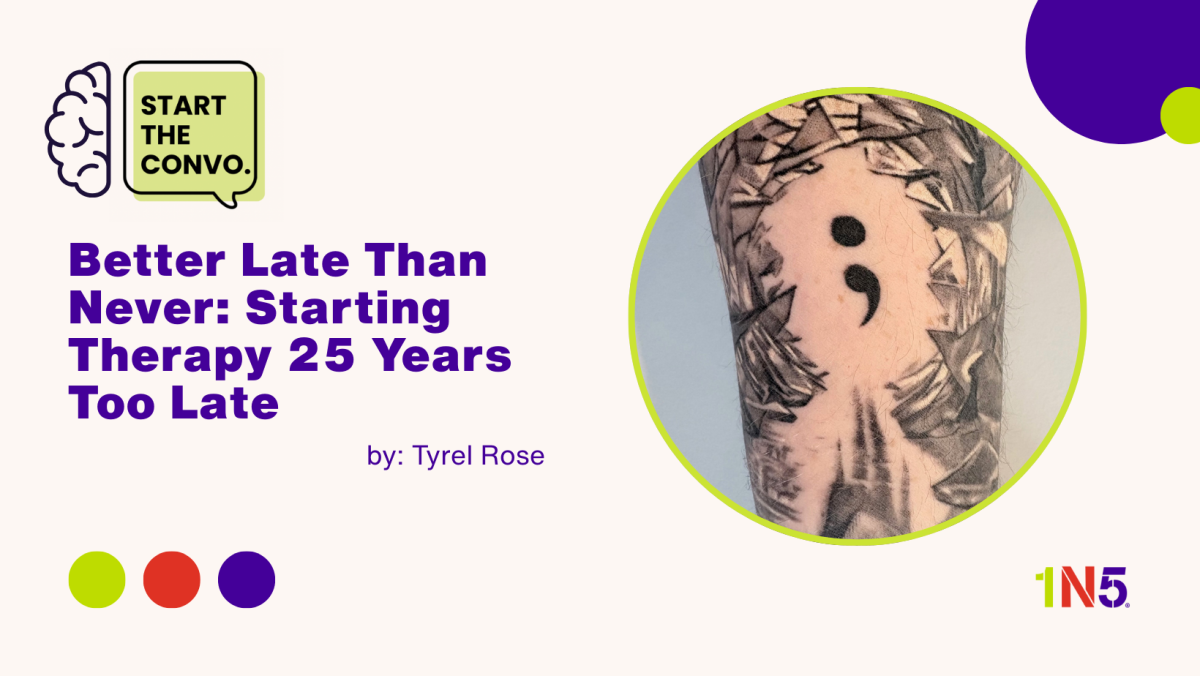
Almost a year after starting therapy, I got a tattoo. It’s a broken mirror with a semi-colon in the middle. The semi-colon is for mental health, depression, and suicide awareness. The broken mirror represents the change in my self-perception, or at least the change I’m working towards.
Instead of walls to hide things behind, I’ve got a permanent reminder of the work I’m doing, the progress I’m making.
I started my mental health journey 25 years too late. But better late than never.