
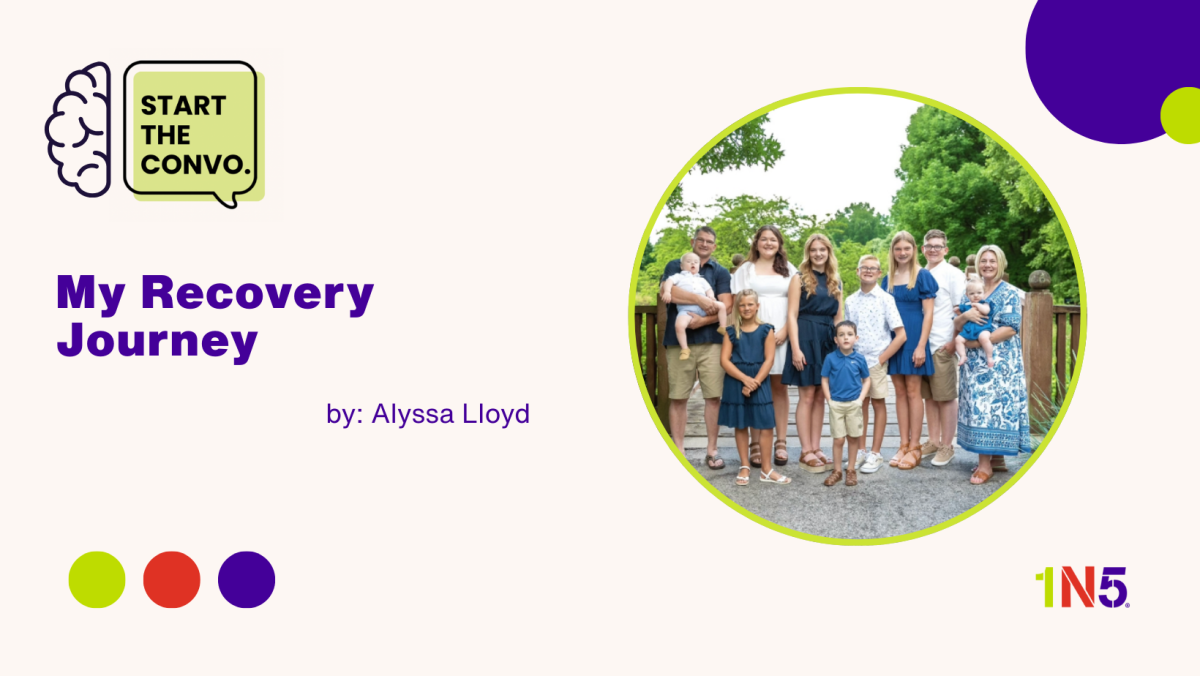
Hello, my name is Alyssa Lloyd, and I am a Certified Youth Peer Supporter with Americorps, Talbert House, and 1N5.
I speak to you all to show you that healing is possible. Everyone’s recovery journey looks different. For a long time, I struggled with anxiety — a constant fight-or-flight response shaped by my biological parents’ lack of care. I grew up with an absent father, my mother, and two siblings, with me being the middle child.
My mother had a hard time keeping a job, and substance use was a part of her life. There were often different people in and out of our home, and stability was something we rarely had. We moved around frequently, couch-surfing and going without basic needs like consistent meals, healthcare, or even a warm bath.
As a child, I didn’t have much time to process how I felt about my situation — I just knew I had to survive it. Even though I was the middle sister, my role was caretaker and parent in one. It came with responsibilities early on. No food? I’d find a way. Nowhere to sleep? I’d find a way. I made sure they got up for school each morning, even if it meant I missed my own bus. My siblings would be taken care of to the best of my ability; that was my bottom line.
In middle school, I was even cited for truancy — not because I didn’t care about school, but because I was doing my best to take care of my siblings and survive myself. These experiences stretched across my entire childhood.
At two, I was in foster care and again at 13. I have had dozens of case workers in my lifetime. Even when I felt like my cry for help was loud, my mother was able to disprove or downplay the allegations made by CPS. There were periods when my mother was incarcerated for months, and even then, child protective services never stepped in, or at least not like they should have.
My siblings and I were left to navigate things on our own, running the streets and trying to stay safe. During different times, we faced near-death experiences, witnessed overdoses, and saw self-harm from people who were supposed to be caring for us. I personally experienced nine out of the ten traumatic experiences on the ACE test.
Those experiences shaped me deeply. I still live with PTSD and anxiety from parts of my childhood, but I’ve also learned to acknowledge how much strength it took to survive. Recognizing that truth is part of my recovery — it reminds me of how far I’ve come and how resilient I truly am. I always told myself as a little girl that I would get out of my hometown and be nothing like the people who resided there. My turning point came when a caseworker finally saw the truth of what was really happening in our lives. We were removed from our home, and what I didn’t know then was that I wouldn’t be coming back.
Being taken away meant losing all my family and friends, but for the first time, I had stability.
My siblings and I were all placed in the same home, and although we eventually went different directions, that was by our own choice. For the first time, I didn’t have to take care of anyone else. I could focus on myself — my education, my mental and physical health, and learning who I was outside of survival.
During that time, I learned about some of the disorders I live with and began to understand how to manage them. I started therapy, which helped me process what I had been through. Eventually, I was adopted and began building a relationship with a new family. That process wasn’t easy, but it taught me what trust, patience, and healing could look like.
Over time, I started doing the “normal” things I once thought were out of reach — making friends, getting a job, earning my driver’s license, and eventually applying to college.
Those moments marked the start of a new chapter for me — one where I could begin building a future instead of just surviving my past. Recovery is not about doing everything alone. The people who helped me the most in my recovery was my biological aunt, who recently passed away. She would take us in, feed us, and was always there when we needed her.
My pastor and his wife also played a big role — they gave us food, shelter, and a place to shower when we had no running water. Before entering our foster home, they took us in for the entire summer, which made the transition a little easier.
My adoptive parents have shown me an incredible amount of patience and understanding. For a long time, I went everywhere my adoptive mom went — that connection helped me feel safe again.
Going through all of this alongside my siblings also made me feel less alone. Even now, being able to tell this story and say we instead of I makes it easier, even though this is my personal recovery journey.
Recovery hasn’t been a straight line. There have been challenges, but I’ve learned new tools, built a strong support system, and discovered parts of myself I never knew existed.
I take medication for both my mental and physical health, and I continue therapy, where I’ve learned healthy coping strategies and how to set boundaries. Every day, I’m reminded that recovery isn’t about perfection — it’s about progress, connection, and allowing yourself to grow through what you’ve been through.
Recovery is a choice you make every day.
Today, I use my story to help others know they aren’t alone. Working at a nonprofit has shown me the power of vulnerability and community. This actually is not the first time I have shared my story publicly. It was hard the first time, but just like everything else, it gets easier. I hope to share it with many others. My message to you all is that healing is possible. It’s not about being perfect — it’s about being willing to take one step at a time.