
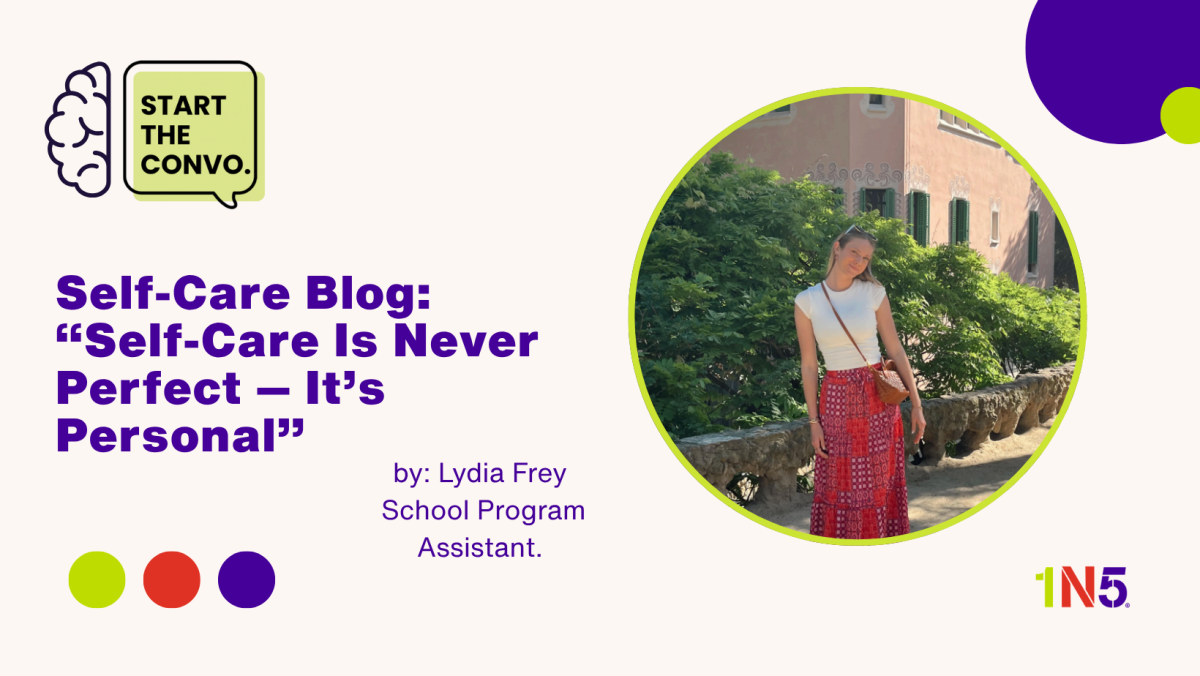
intern and then transitioned to work directly under our school team as the School Program
Assistant. I was born and raised in Cincinnati, Ohio, and then moved to Columbus to attend The
The Ohio State University for undergraduate school, where I studied strategic communications and
psychology. After that, I returned to Cincinnati to continue my education at Xavier. I am currently
working part-time at 1N5 as I work to become a licensed School Counselor and Clinical Mental Health Counselor. As you could guess, my life is extremely busy and chaotic, just the way I like it
it. As I work to navigate all of these different aspects of my life, like getting my schoolwork done,
showing up for my job, showing up for my friends and family, networking, moving my body, and
more, I have developed my own personal toolbox for self-care.
Self-care is extremely important for many reasons. Self-care tools can reduce burnout,
reduce stress, and improve overall emotional regulation. With my passion for mental health, my
self-care journey has come a long way. In high school, I took AP Psychology, which is where I
fell in love with learning about mental health. During this time in my life, my self-care strategies
involved spending time with my family and my dogs after school and sports practices, spending
time outside with my siblings and neighbors, and journaling about my day. College was a difficult
transition for me as I learned to make completely new friends, become independent, prioritize
school, and push myself out of my comfort zone. During my college years, my self-care
practices included going to the gym, taking long walks around campus, learning time
management, and setting boundaries. Now, I am back home living with my parents, and I have
learned so much about myself over the past few years. I am now studying to become a future
counselor, and I feel very confident in the skills I have to prioritize both my physical and mental
health through self-care.
I believe that you need to have a multitude of self-care practices in your back pocket in
order to keep yourself happy and healthy as you navigate a busy lifestyle. So, I am going to
walk you through some of my current self-care favorites using the following categories:
emotional, practical, physical, mental, social, and spiritual.
Emotional self-care for me involves recognizing and processing my emotions in healthy
ways. One of my biggest emotional self-care tools is journaling. Writing down your thoughts,
something you are grateful for, or something good about your day helps you slow down and
reflect on how you are doing and feeling. I like to use a gratitude journal with prompts so that I
have questions to go off of, but free-writing journal entries can also be a really great way to
allow yourself to process situations and emotions instead of pushing them aside. Any kind of
mindfulness is a great form of emotional self-care.
Next, a form of practical self-care for me is simply staying organized, time blocking, and
creating schedules and to-do lists. Practical self-care may not always feel exciting, but it makes
a huge difference when life gets busy. Some skills I recommend practicing include keeping a
calendar and a to-do list for school and work assignments, time blocking your days, laying out clothes, packing snacks for long days, meal prepping, and blocking out time in your day to text
or check in with a loved one.
Next is physical self-care, which is my personal favorite way to take care of myself.
Movement plays a huge role in my life, and it always has. I grew up as a three-sport athlete in
middle school and high school, and movement quickly became a part of my life that I would
never put on the back burner. At this point in my life, I enjoy hot yoga, Pilates, HIIT classes,
weight lifting, walking, and running. Some days look like a structured workout class with a friend,
while other days involve a simple walk outside to clear my mind. I have learned over time that
physical self-care is not about pushing myself to my limits with exercise, but rather about
listening to my mind and body and choosing movement that gives me energy and motivation to
fuel my day. Another form of physical self-care that I have recently been prioritizing is fueling my
body with whole foods. Eating whole foods supports mental health by providing essential
nutrients that fuel brain function and stabilize mood.
In terms of mental self-care, I try to practice this by setting realistic goals for myself each
day, taking breaks when I need them, and allowing myself time to rest and get enough sleep
every night. This form of self-care is especially important as a graduate student. Right now, my
favorite mental self-care tools are listening to podcasts and continuing to learn about wellness.
Social self-care is something I also deeply value. Spending quality time with people who
support and uplift me helps me feel grounded. For me, this looks like going on a walk with a
friend, cooking dinner with my family, watching movies with my partner, or attending a workout
class with my sister. Making time for meaningful connections reminds me that I am never alone,
even during stressful seasons of my life.
The last form of self-care I practice is spiritual self-care. This category is really cool
because it can look different for everyone. For me, this looks like finding moments to reflect on
the peace and gratitude I have in my life.
If there is one thing I have learned throughout my self-care journey, it is that self-care is
different for everyone. What works for me may not work for you, but the most important thing is
to accumulate a toolbox of practices that feel realistic and meaningful to you. I encourage you to
start small. Self-care does not need to look like buying the newest trendy face mask or booking
a spa getaway. It can be as simple as practicing a breathing exercise each day, going for short
walks after meals, or writing down one thing you are grateful for every night. Over time, small
habits build into a strong foundation.
Self-care is not selfish; it is necessary. My hope is that by sharing my experiences,
Others will feel encouraged and empowered to explore their own self-care practices and give
themselves permission to prioritize their mental health.