
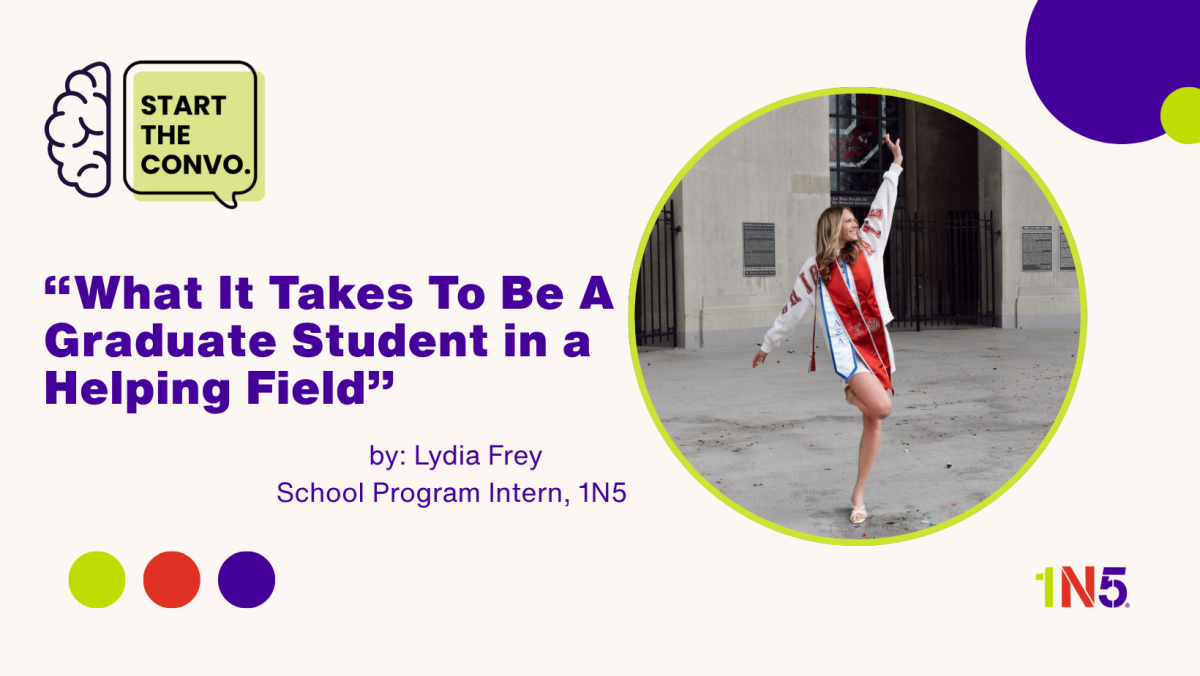
My name is Lydia Frey, and I have been interning at 1N5 for about two years now. I began my journey as a general intern and then pivoted to work directly under our School Programming team. I was born and raised in Cincinnati, Ohio, and then moved to Columbus to attend The Ohio State University for undergraduate school, where I studied strategic communications and psychology. During this time, I fell in love with the idea of going into a helping profession. After a ton of career exploration and taking advice from numerous mentors, I decided to apply to counseling programs. After that, I returned to Cincinnati to continue my education at Xavier. I am currently working part-time at 1N5 as I work to become a licensed School Counselor and Clinical Mental Health Counselor. As you could guess, my life is extremely busy and chaotic, just the way I like it.
People often ask me why I chose this career path, and honestly, the answer goes back to some experiences I had growing up. During high school, my community experienced the tragic loss of two classmates to suicide. Watching the confusion, grief, and heartbreak that followed opened my eyes to how important mental health awareness and support truly are. It also made me realize how many people are struggling silently. Around that same time, I was introduced to the work 1N5 was doing in schools and communities across Cincinnati. Watching these conversations around mental health become more open and accessible had a huge impact on me and ultimately inspired me to pursue a career where I could directly support others.
As I moved through college, my passion for mental health only continued to grow. Studying psychology helped me better understand human behavior, emotions, and the many factors that impact mental health, while strategic communications taught me how important connection and conversation are in reducing stigma and helping people feel seen. I quickly realized that counseling would allow me to combine both of these passions in a meaningful way.
During my time at Ohio State, I also learned that helping professions require so much more than simply wanting to help people. They require empathy, patience, flexibility, emotional awareness, and the ability to truly listen. After lots of self-growth, self-awareness, and self-work, through volunteering opportunities, leadership roles, internships, and working with students, I began developing those skills in real-life settings. My internship at 1N5 especially solidified my decision to become a counselor. Being able to work alongside professionals who dedicate their lives to supporting students, educators, and families showed me how impactful this work really can be.
Now that I am in graduate school, I have gained an even deeper appreciation for what it means to work in a helping field. Graduate school is incredibly rewarding, but it is also challenging in ways I never fully expected. Balancing classes, internships, work, studying, and personal life can feel overwhelming at times. In a helping profession, you are not only learning academic material, but also learning how to show up for others in difficult moments while still taking care of yourself. I have learned very quickly that self-care, boundaries, and balance are not optional in this field; they are necessary.
One of the biggest lessons graduate school has taught me so far is the importance of being comfortable with growth and discomfort. Counseling is a field where you are constantly learning, reflecting, and evolving, both professionally and personally. Some days are exhausting, some days are emotional, and some days leave me questioning whether I am doing enough or doing it right. But there are also moments that remind me exactly why I chose this path. Even small moments of connection, understanding, or support can make such a difference in someone’s life.
After I complete my master’s program, I hope to work with children and adolescents in either a school or a clinical mental health setting. My goal is to help young people feel supported, understood, and equipped with healthy coping skills before they reach a point of crisis. I also hope to continue advocating for mental health awareness and reducing stigma surrounding mental illness, especially within schools and communities.
At the end of the day, being in a helping profession is not always easy, but it is incredibly meaningful work. It challenges you to grow into the best version of yourself while allowing you to support others as they navigate their own challenges. I still have so much to learn, but I am grateful every day for the experiences, mentors, classmates, and opportunities that have led me to this point in my journey. If there is one thing I have learned so far, it is that helping people does not require perfection; it simply requires compassion, authenticity, self-care, and the willingness to show up.